Tuesday, November 13, 2007

The Channel Rush

It started with the news veteran NDTV announcing its foray into the General Entertainment Channels (GEC) genre. Such a move had been unheard of in the past and the whole industry sat up and took notice. While GEC majors like Zee and Star have news channels in their bouquet, never before had a ‘news-only’ player ventured into GEC waters. While the announcement in itself was a landmark in the history of Indian media, other related happenings are having quite an impact on the whole industry per se.

For the new company - NDTV Imagine (which will launch their lifestyle channel NDTV Life), Dr. Prannoy Roy lured Sameer Nair, one of the CEOs of Star Entertainment and Karan Johar. Star’s other honcho Peter Mukerjea also bid goodbye to start his own company (well, almost!) which has plans to launch 8-12 channels in future. Meanwhile, Zee TV which had been lying low for quite some time has bounced back with a vengeance and is rattling market leader Star to its very bones. Combine all this and you have a channel that ruled the Indian television space for the last 7 years going weak in the knees with market share slipping from its hand faster than water receding from a sea shore.
For Complete IIPM Article, Click on IIPM Article

Source: IIPM Editorial, 2006
An IIPM and Management Guru Prof. Arindam Chaudhuri's Initiative

Tuesday, October 30, 2007

‘Avenues for Private Sector Participation in Defense’

One needs to understand that any country, which aspires to be a global power, cannot remain indefinitely dependent on the outside world for too long (during the period 2004-2007, India’s defence import ‘Avenues for Private Sector Participation in Defense’expenditure stood at whopping $10.5 billion. India is the third largest arms importer in the world; among the developing countries, it tops the list of defence hardware). India’s current dependence on foreign arms is quintessentially a stopgap arrangement before it can attain the expertise to stand on its own feet in terms of arms production. It is this realisation, which has led the government to reform the Indian arms manufacturing industry. Much in consonance with the DRDO objectives of achieving 70% indigenization in defence production by 2005 (unfortunately, only 30% has been achieved till date); guided by the recommendations of Dr. Vijay L. Kelkar committee (constituted in 2004) and Associated Chambers of Commerce and Industry of India (ASSOCHAM) 2007 paper titled ‘Avenues for Private Sector Participation in Defense’, the government finally decided to undertake revolutionary measures to chaperon the Indian private firms into hallowed precincts of the Indian defence. That the government has finally agreed to grant the status of “Raksha Udyog Ratan” (RUR) status to a selected few Indian companies, to provide products and services support to the Indian armed forces, is indeed an unprecedented step in the history of independent India. According to Brigadier Khutab Hai, CEO, Mahindra Defence Systems, “We should be allowed to develop high-tech weapons platforms by benefitting from R&D funding, sharing knowledge with the DRDO and working with the services headquarters to have a clear idea of their requirements well ahead of time.”

For Complete IIPM Article, Click on IIPM Article

Source: IIPM Editorial, 2006

An IIPM and Management Guru Prof. Arindam Chaudhuri's Initiative

Home Campus Tour Contact Us Sitemap IIPM Think Tank IIPM National Brochure IIPM in Media India Today & Tomorrow

Strategic Alliance / Consulting / Intellectual Tic-up Partners Arindam chaudhuri GIDF Planman Consulting Business & Economy 4Ps Business & Marketing The Sunday Indian The Daily Indian Kkoooljobs.com

Tuesday, October 23, 2007

First blood...

Bull runs, whether in Spain or at the NASDAQ, have a very predictable course of events… the excitement, the euphoria, as well as the bloodbath that follows. For quite a while, a bull-run led by PE firms is sweeping across markets, like a tsunami at the height of its ferocity. “In 2003, there were only 16 pure private equity listed entities with a daily turnover of more than $1 million & an M-cap greater than $250 million. As of 2007, these numbers have nearly doubled,” says David Blitzer, MD & Chairman, Index Committee, Standard & Poor’s.

The recent buyout offer for Bell Canada (a 127-year-old Canadian telecom operator) by a group of PE firms, for a whopping $48.5 billion is the latest crest of this wave. The offer is the biggest in the history of private equity, outshining the $45 billion acquisition of TXU Corp. by KKR & Texas Pacific Group, Blackstone’s offer of $26 billion for Hilton Hotels & a $22 billion bid for Virgin Media by Carlysle group. A result of this bull-run is overpriced offers with elephantine premiums. Take the Blackstone offer: it represents a 40% premium over Hilton’s closing price the previous day.

For Complete IIPM Article, Click on IIPM Article

Source: IIPM Editorial, 2006
An IIPM and Management Guru Prof. Arindam Chaudhuri's Initiative

Wednesday, October 17, 2007

“In fi ve to six years there’s going to be a totally diff erent format of retailing, which is going to change the consumer’s perception of shopping”

Now look at the situation from our perspective. All those hyped up Kishore Biyani, Chief Executive Officer, Future Goupreports from consulting firms talking about how footfalls would convert into purchases simply have turned out to be balderdash, what with a massive number of people visiting retail malls simply for the ‘experience’ of it, rather than to purchase anything. An analyst on Pantaloon’s panel himself confirmed to us, “Yes, there are high footfalls in malls; but actual shopping does not take place.”

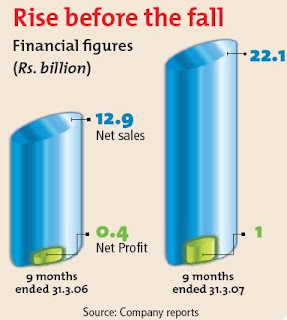
Worse, with more & more competition, costs are expected to increase prohibitively, eating away customers & margin figures. Think about it. Biyani’s company’s manpower Financial fi gurescosts have risen by a whopping 118% to reach a gargantuan Rs.1.5 billion for the same 9-month period mentioned previously. And now, according to the most damning statistical research by Wharton analysts, because of over-crowding of too many players in this business, a soul stopping 70% of the malls will horribly fail the test of time. KSA Technopak is more lenient in its report which mentions that while about 600 malls will be built by 2010, 50% of those will make losses! Even a report by Jones Lang LaSalle Meghraj Research projects that 90% of Indian malls fall below international standards. And the report states that, “many will fail the test of time as more choice becomes available for the Indian consumer, who will become increasingly discerning...”

For Complete IIPM Article, Click on IIPM Article

Source: IIPM Editorial, 2006

An IIPM and Management Guru Prof. Arindam Chaudhuri's Initiative

IIPM, Business College Ranking India BBA Institute India, IIPM IIPM - Nikhil Khade Online Welcome to 4Ps Business and Marketing The IIPM Think Tank IIPM New Delhi India Professor Arindam Chaudhuri, Renowned Management Guru & Economist IIPM Info Planning and Entrepreneurship Programme, IIPM New Delhi, India Business And Economy IIPM Placements New Delhi, India IIPM Business Management Institute India


.